

 Englisch
  Deutsch
 The Central State Office for Distance Learning (ZFU) has approved the course Business Intelligence under the number 1152923.
 - 3 flexible time models from full-time to part-time for every life situation
- interesting specializations, such as in Machine Learning or User Interface Design
- innovative learning concept with IU Learn app and digital lectures
Business Intelligence (B.Sc.): Target Group and Admission Requirements Overview

The Bachelor's programme in Business Intelligence at IU International University is aimed at individuals who have a passion for data analysis, IT, and economic relationships. It is particularly suitable for those who are technically and analytically minded and want to optimize individual processes in the company through data-driven solutions. The programme is ideal for professionals or high school graduates who are looking for a flexible and practical entry into the world of Business Intelligence, regardless of whether they are reorienting themselves or deepening their professional knowledge.
Admission Requirements: Who Can Enroll in Business Intelligence (B.Sc.)?
With Abitur (German high school diploma) or Fachhochschulreife (vocational baccalaureate):
The classic entry is through general higher education entrance qualification (Abitur), subject-specific higher education entrance qualification, or vocational baccalaureate (Fachabitur including internship). With one of these qualifications, direct admission to the bachelor's programme is possible.
Without Abitur or equivalent:
Even without Abitur, you can start your studies if you meet one of the following alternatives:
- Master craftsman's certificate or advanced training: A master craftsman's certificate or successful completion of further training such as IHK specialist or state-certified business administrator is recognized as entry qualifications.
- Vocational training plus professional experience: If you have completed at least a two-year recognized vocational training in Germany and can then demonstrate at least three years of relevant full-time work experience, you qualify for a trial study. The professional relevance of your training or experience to Business Intelligence is advantageous but not mandatory.
Special rules for international applicants:
For international educational qualifications, the university checks the equivalence (according to Anabin). Proof of German language skills at level B2 (e.g. TestDaF, DSH, Telc, or ÖSD) is required for the German-language programme.
No numerus clausus (NC) - no application deadline:
IU does not impose a numerus clausus, so the study can be started without a selection process or waiting period. A start is possible at any time throughout the year.
Personal Requirements: What Should You Bring for the Study?
- Analytical skills: You should have an interest in numbers, data, and their systematic evaluation.
- Technical affinity: Basic knowledge or at least an interest in IT, programming, and software applications are helpful.
- Self-organization and motivation: Since the study is completely online and flexible, self-motivation and independent learning are particularly important.
- Team and communication skills: Communicative skills are advantageous for projects or exchange in the online campus.
- Willingness to continuous learning: The rapid development in the field of data analysis and IT requires openness to consistently engage with new tools and methods.
The Bachelor's programme in Business Intelligence at IU is suitable for both career starters and experienced professionals who want to expand their knowledge in data management, business analytics, and digitization.
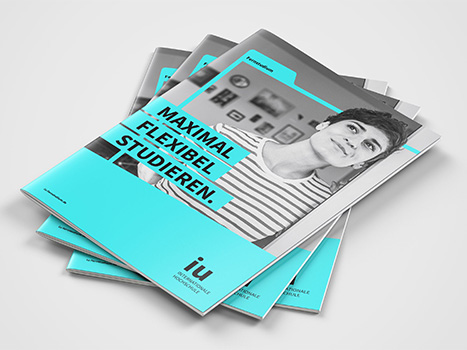 All information about requirements, content, specialization options, and costs can also be found in your personal information package for online studies in Business Intelligence. With the brochure, you will also receive access data for a demo account of myCampus, the IU online campus. Request brochure now...
What content do you learn in the Bachelor Business Intelligence?
In the distance learning course Business Intelligence at IU International University, you will acquire expertise in the collection, processing, and analysis of large amounts of data - and their targeted use for data-based decision-making in companies. The focus is on how data is systematically collected, stored, processed, analyzed, and visually presented. At the beginning, you will learn mathematical and statistical basics as well as initial programming skills (for example, with Java) and working with database systems.
- Introductory modules: Digital Skills, Introduction to Academic Work, Basics of Mathematics and Statistics
- Technical basic modules: Data Modeling, Database Systems, Object-Oriented Programming, Project: Data Mart Creation in SQL
- Business Intelligence and Data Science core modules:
- Business Intelligence
- Data Management & ETL (Extract, Transform, Load)
- Big Data Technologies
- Data Visualization
- Advanced Data Analysis
- Data Analytics and Big Data
- Cross-functional competences: Business Administration, Project Management (Agile & Classic), Process Management, Controlling, Cost and Performance Accounting, Intercultural and Ethical Action Competencies
- Practice Transfer & Project Work: Each semester is completed with a practical project (e.g. in Business Intelligence, Data Analysis, Strategic Development).
- Optional specializations (three elective modules): Here you can specialize in areas such as Machine Learning, User Interface Design, Business Consulting, Data Engineering, Sales & Controlling, Agile Software Engineering, IT Security, E-Commerce, Supply Chain Management, or Salesforce Management. This way, you can develop practical skills according to your interests.
- The study is rounded off by the Bachelor thesis, in which you work on your own project in the field of Business Intelligence.
Typical acquired skills:
- Designing and managing databases
- Analyzing data using SQL and modern tools
- Building Data Warehouse architectures
- Targeted use of Big Data technologies and data visualization
- Considering risk management and data protection in data processes
- Developing analysis strategies for business questions
How does the study work?
You study Business Intelligence 100% online and adapt your studies flexibly to your everyday life. IU allows you to start your studies at any time and without application deadlines. You can choose between three time models:
- Full-time: 6 semesters (36 months), for those who want to graduate quickly
- Part-time I: 8 semesters (48 months), ideal for studying alongside a job
- Part-time II: 12 semesters (72 months), if you want to greatly reduce your study workload
You study the content via a modern digital learning platform - with your own interactive "IU Interactive Books," video lectures, podcasts, quiz questions, and regular virtual lectures. Study materials are available digitally and in print. You can take exams flexibly: Online exams are possible around the clock. Alternatively, exam centres are available if you prefer traditional in-person exams.
Highlights of the process:
- Each semester ends with a practical project where you directly apply what you have learned.
- Elective modules offer you the opportunity to set individual priorities.
- Throughout your studies, you receive technical and specialist support from Study Coaches, tutors, and professors as well as an AI-based learning assistant.
- IU allows free extensions of up to 12 months if you need more time - plus a trial month at the beginning.
What career opportunities await you after graduation?
With a Bachelor's degree in Business Intelligence, you are prepared for highly sought-after fields at the intersection of Data Science, IT, and Business Control. Graduates work across industries in companies, organizations, and consulting firms - wherever data-driven decision-making is crucial.
Typical professions after graduation:
- Business Intelligence Analyst: You design and implement BI solutions, create dashboards, analyze key figures, and support management with strategic data analysis.
- Business Intelligence Solution Architect: You design and implement complex Data Warehouse and reporting architectures.
- Data Analyst / Data Scientist: You use data analysis and Machine Learning to gain business-relevant insights.
- Consultant for Data Management, Reporting, or Digitalisation
- Data Warehouse Specialist in large companies
Typical fields of application can be found in industries such as manufacturing, retail, finance, e-commerce, logistics, or IT service providers - anywhere data is needed as a basis for decision-making. With your analytical and technical skills, you are ready for leadership roles in Data Driven Companies or for entry into advanced Master's programmes.
Costs and Financing: What does the distance learning course cost?
The monthly fees for the Business Intelligence distance learning course at IU depend on the chosen time model:
- Full-time (36 months): from €399 monthly, total costs approx. €15,063 including graduation fees
- Part-time I (48 months): from €344 monthly
- Part-time II (72 months): from €259 monthly
- Graduation fee: around €699 once at the end of the course
During the regular study period, all learning materials, digital tools, and support services are included.
Financial options include:
- BAföG (subject to meeting requirements)
- Study loans and education funds (e.g. KfW)
- Tax deductibility as business expenses (for professional reasons)
- Employer support and scholarships
IU offers regular discount promotions and a free trial month. By recognizing prior learning, you can further reduce study time and costs.
 Lade…
Lade…
Experiences & Reviews
Also interesting 👇


Source of this course information: Vendor Website
Advisory Service
Have questions about Academic Programs Business Intelligence? Ask your question here, even anonymously. An employee of the institution IU International University or the editorial team will answer you.